Here’s my first real timelapse video (as in, not shot on the “timelapse” mode of my point-and-shoot). Timelapse is well-suited for subjects that move slowly — so, of course, I decided my subject should be bike racers, whose sole purpose is to move fast. Why would I do that?
Well, it seemed like a good opportunity to show the event — the Sea Otter Classic — in a new way, and it was a good opportunity to experiment with timelapse.
This whole movie is made up of frames from my regular digital camera. If you consider that each second of the video is 24 frames, then I had to shoot 240 frames for ten seconds of footage. Then all those frames are combined — at full resolution — into a Quicktime movie file. A huge file. The benefit to doing this is that because you have all this resolution, you can pan around inside your video, which I did throughout.
In most timelapse videos, a frame is shot every second or so. But because I was trying to capture fast-moving bikes, many of these clips were shot with the motor drive going full blast, eight frames a second. I turned down the jpeg quality to medium (hey, this is web video) and was able to shoot for quite awhile before the buffer filled.
There are quite a few things you’ve got to wrap your mind around before successfully doing a video like this, and I had a lot of help from smart people online. Here are the resources I used to learn how to do timelapse:
Here’s the top three useful things I learned about making timelapse videos with a digital camera:
Your shutter speed should be about half of the time between exposures — so if you’re taking a picture every second, your shutter speed should be about a half second.
To get those long shutter speeds in bright sunlight, you need good ways to limit the amount of light getting into your camera — like neutral density filters that are almost completely black.
A lens’ aperture blades don’t close down in a perfectly consistent manner every time — so even though every one of your exposures was a half second at f32, some frames will be brighter than others, and that will be noticeable when the video is played back. It’s called flicker. To minimize this, find a way to get your aperture blades locked down for the entire sequence. If you’re shooting with a Canon DSLR like me, you can hold down the depth-of-field preview, then twist the lens halfway off the body like you’re going to remove it. This will decouple the lens from the camera’s controls but the aperture blades will stay stuck down. Tricky!
Other notes: I composed the music for this video using apps on my iPhone and a multitrack recording program. Edited in Final Cut Pro. Total number of frames shot: I have absolutely no idea!
I just returned from a vacation in my former home state of Ohio, where I lived from 2000-2002. I met my wife there before the two of us left for California together. This trip was to see her family and old friends. I had an amazing time. I also shot a photo essay with my iPhone.
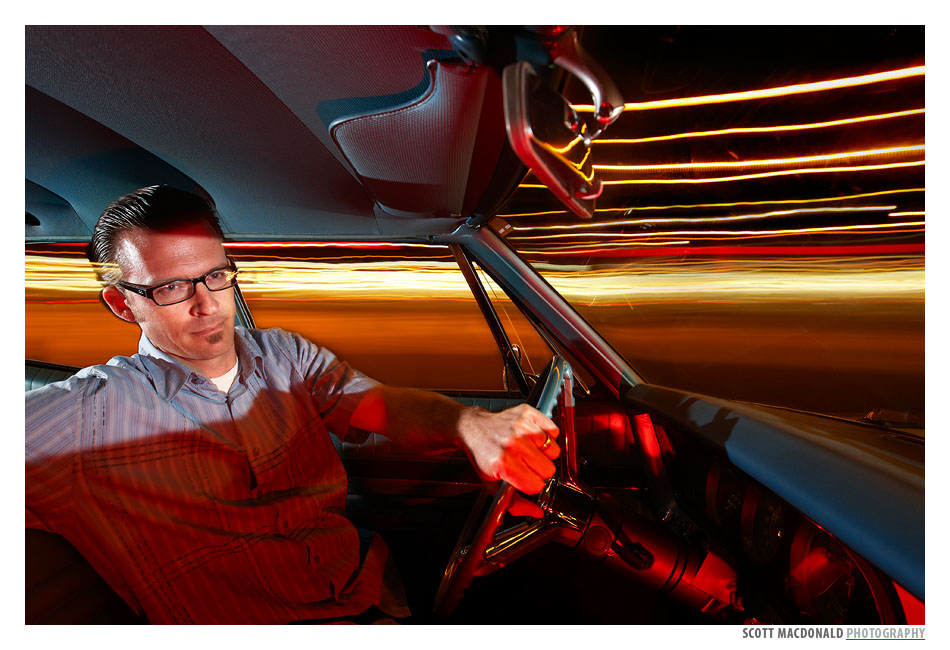
Why, when thinking up a lighting scheme, do I insist on things like, “The flash will fire at the camera but instead hit a mirror which will light the subject’s face, and oh, by the way, the camera will be clamped to a car while it’s driving down an alley and let’s make sure there’s no lens flare and we have to get all this just perfect before sunset because there’s another shot to do with another tweaky and annoying lighting setup.” (?!)
And so, I found myself adjusting a lens hood made out of gaffer’s tape as I ran next to Glen’s vintage car down an alley, gently supporting a camera on a magic arm clamped to the door, firing off a single frame as we got up to speed, urging Glen not to move his head too much or the circle of light created by the finely-adjusted side view mirror won’t fall on the right spot.
It worked, as you can see from the photo above. But it certainly helped that I had help.
It helped that the subject was Salinas portrait and pin-up photographer Glen McDowell, who frequently has me work with him at weddings. It helped that Glen’s assistant Annette was there, and it helped that my pal Travis Geske came along. Both helped with key suggestions on lighting and by moving gear.
Here are some photos from the shoot made by Travis:
This shoot was a self-assigned project — I wanted to do a portrait like this, Glen wanted some new portraits for his new website (and honestly, I owed Glen some favors). There are more such self-assigned portrait projects in the works.
For years, Paper Wing Theatre Co. has been persistently producing the most challenging theater in Monterey County, California. They do their plays on shoestring budgets, with beginning performers and in venues that sometimes lacked heat (and often lacked big crowds). This theater company has heart.
And for years, I’ve been photographing their productions in both Salinas and Monterey for their publicity campaigns. The photos went out to local publications; some were printed and hung in the theater’s lobby. Today I’m adding a new place they can be found: in my Photoshelter archive, available for purchase and download.
Over the years, many actors have asked me about getting prints of photos from past productions. They’re all available now, and I’m offering a special coupon to get things started. The first 15 people to use the code “PAPERWING” on checkout will get 30% off their order. I’m keeping the print prices really low, so there’s a real bargain available here for people who hurry.
So whether you appeared in one of the many infamous productions of Rocky Horror or you were part of the huge cast of Guys & Dolls, or you were in the recent multimedia musical The Wall, head on over to the archives and poke around.
Here are a few of my favorites.
(02-24-07 — A Clockwork Orange)
01-13-08 — Bill W. and Dr. Bob
In 1929, famous stockbroker Bill Wilson crashes with the stockmarket and becomes a hopeless drunk. Dr. Bob Smith, a surgeon from Ohio, has also been an alcoholic for thirty years, often going into the operating room with a hangover. Through an astonishing series of events, these 2 meet and form a friendship, each helping to keep the other sober. This is the amazing and often humorous story of the two men who pioneered Alcoholics Anonymous.
Contact:
Koly McBride (831) 675-0521
Lj Brewer (831) 521-4512
thepaperwingco@yahoo.com
(02-24-07 — A Clockwork Orange)
(03-02-08 — One Flew Over the Cuckoo’s Nest)
(05-15-08 — Six Women with Brain Death)
(03-22-06 — Lolita, The Paper Wing Theatre Company)